The Evolution and Importance of Industrial Mixing

The Evolution and Importance of Industrial Mixing

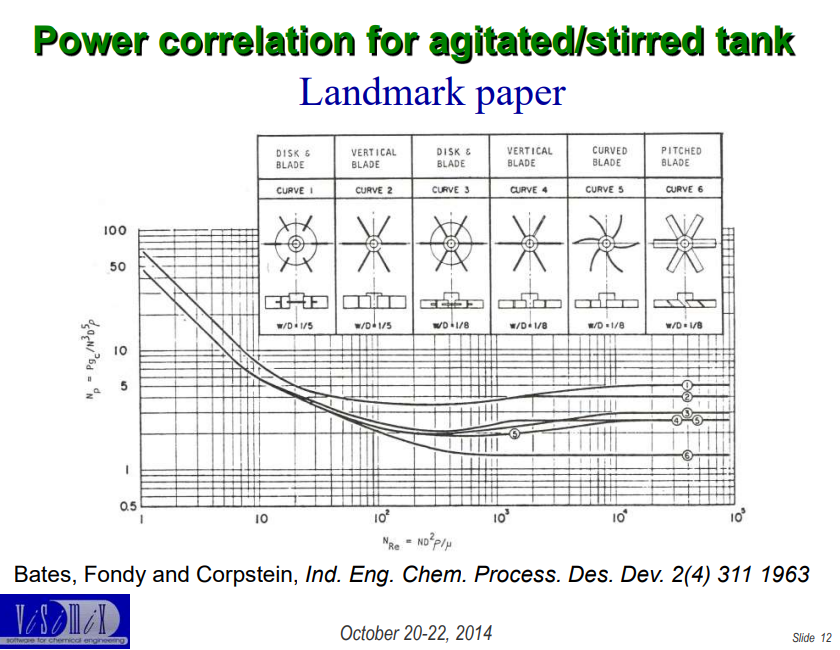
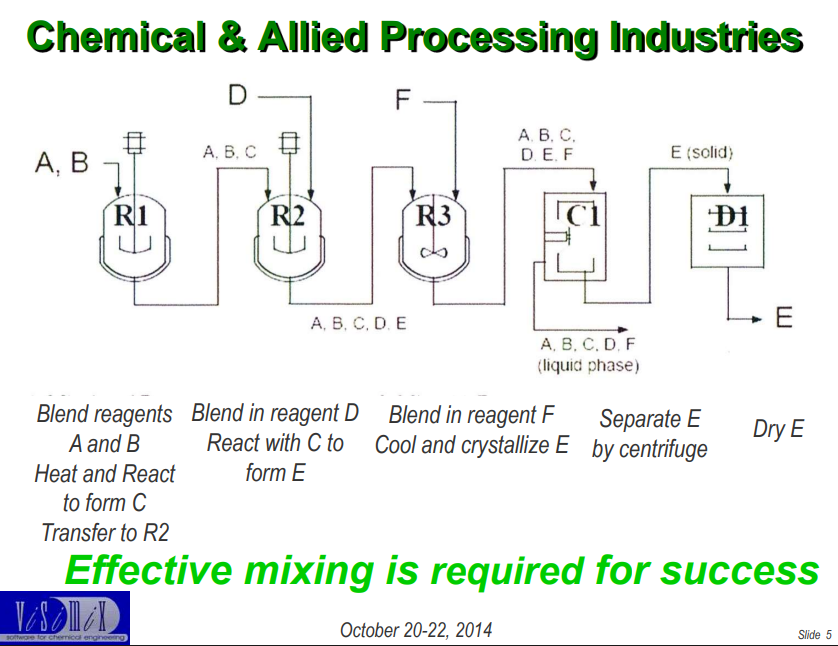
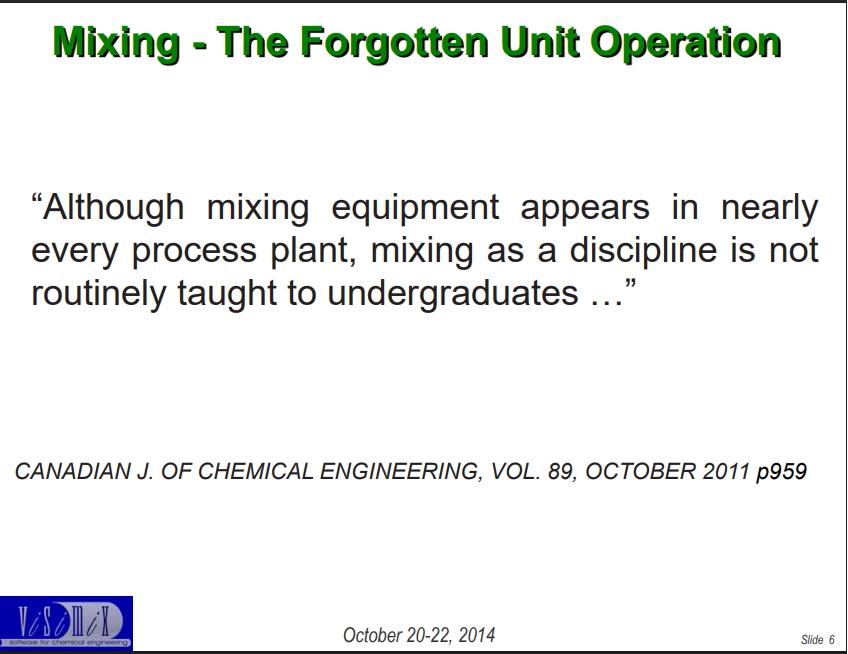
Often referred to as "The Forgotten Unit Operation," mixing is fundamental to the success of the chemical and allied processing industries. As outlined by Victor A. Atiemo-Obeng at the 2014 VisiMix Conference, mixing was historically overlooked—such as in 1970s Epsom salt crystallization processes where mixing was not even mentioned—before gaining standardized recognition with the 2001 AIChE Equipment Testing Procedure and the 2003 Handbook of Industrial Mixing. The consequences of inadequate mixing are severe and costly, leading to lower reaction yields, unacceptable product properties, higher purification costs, and less safe process operations.
 

The Fundamentals: Hydrodynamics and Impeller Design

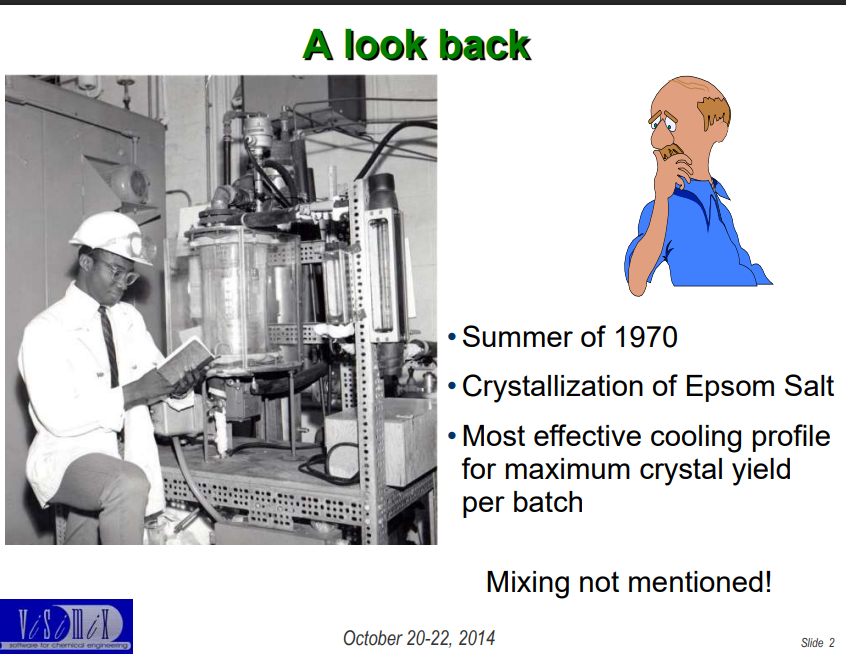
A mixer converts mechanical energy into kinetic energy to induce the desired hydrodynamic environment. Mixing science relies heavily on understanding fluid flow regimes and power consumption:
  • Hydrodynamic Regimes: Flow is characterized by the Reynolds Number, defined as . The regime is laminar when  and turbulent when .
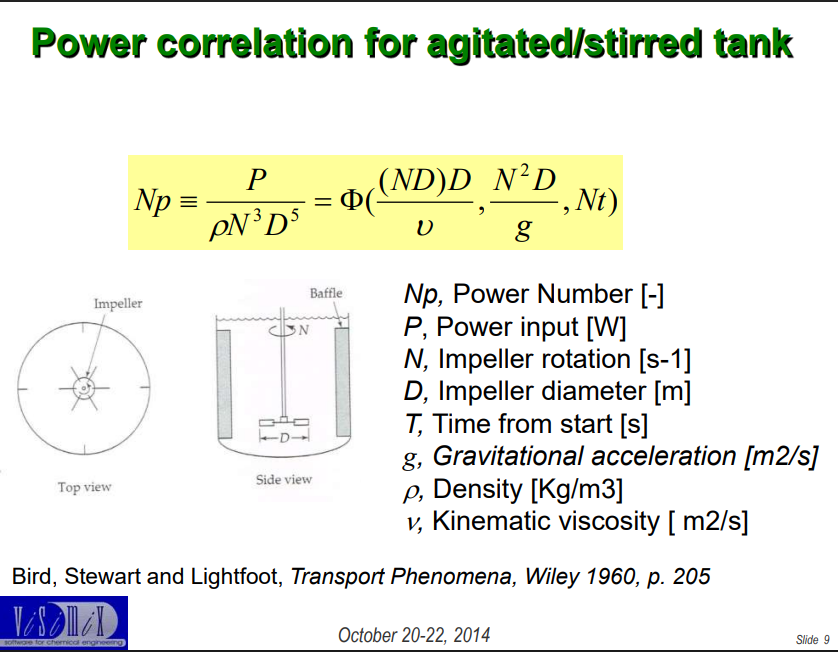
  • Power Consumption: The impeller power correlation relies on the Power Number, defined as .
  • Impeller Selection: Standard impellers are chosen based on process needs: axial and hydrofoil impellers offer high pumping rates for blending, radial impellers provide high local turbulence for gas dispersions, and proximity impellers handle high viscosity processes.
  • Heat Transfer: Adding physical heat transfer area is much more effective than increasing impeller power, because the process heat transfer coefficient scales weakly with specific power, proportional to .


Mastering Multiphase Mixing and Scale-Up

Scaling up mixing processes from pilot to plant scale presents a major dilemma; maintaining constant specific power or constant tip speed results in drastically divergent performance metrics. Multiphase operations each have unique challenges:
  • Solid-Liquid: The minimum requirement for most applications is "complete off-bottom" or "just suspension," meaning no solids rest on the vessel base for more than a few seconds.
  • Liquid-Liquid: Mixing energy dictates drop break-up, but dispersions can be threatened by physical instabilities like creaming, coalescence, and phase inversion.
  • Gas-Liquid: As impeller rotational speed increases, a gas dispersion transitions through states of flooding, loading, and eventually complete dispersion.


Best Practices for Process Development

Successful chemical process development requires an early and careful assessment of mixing effects. For example, in precipitation reactions, feed location drastically alters local supersaturation (defined as ), which dictates whether the process yields uniform large crystals or fine, non-uniform crystals. Developing robust in-house expertise is achieved through a culture of "Learn, Apply, Document, Teach," supported by modern resources like VisiMix software and Fluid Mixing Processes (FMP) consortium guidelines.


VisiMix Video

The Influence of Mixing in the Process
New methodology using VisiMix software for the purpose of checking the influence of mixing in the processes.

VisiMix Demo Operation
Learning how to input data into the VisiMix software and get results the will help us understand the influence of mixing in our processes.

Lab Experiments
Learning how to set up the relevant experiments at the lab scale, to develop the processes from an engineering point of view.

VisiMix
User friendly, universal and reliable Computational Process Engineering software for analysis of processes facilitated by mixing.